
Practical Family Mediation
When families face change, the everyday details matter most. Our structured, neutral mediation service helps you build practical agreements on children's arrangements, shared finances, and household matters — with dignity, clarity, and lasting effect.
A voluntary, confidential process led by a neutral professional — creating space for clear thinking and realistic planning, so families can move forward.

Family Mediators provides calm, practical support for families experiencing change. We specialise in helping people talk safely and productively about the everyday details that matter most — arrangements for children, shared finances, and practical household issues.
Our approach ensures that decisions are clear, implementable, and less likely to spark further conflict. Wherever children are involved, we prioritise routines, stability, and minimising disruption, producing agreements that protect children's day-to-day lives as fully as possible.
Mediation is a voluntary, confidential, and structured conversation led by a neutral professional. The mediator does not take sides or impose outcomes. Instead, they create a safe space for each person to explain their priorities, test options, and reach agreements that feel realistic and workable.
Because you remain in control of the decisions, mediation often produces more flexible, lasting solutions than courtroom orders — and it usually costs less time, energy, and emotional strain.
Family disputes carry significant emotional, financial, and personal stakes. The quality of the process — and the neutrality of the professional guiding it — determines whether outcomes are durable or fragile.
Unlike adversarial proceedings, mediation keeps conversation structured and respectful. This is especially important where an ongoing co-parenting relationship must be maintained after the process concludes.
Litigation is lengthy and expensive. Mediation is typically faster, far less costly, and less emotionally draining — with outcomes that participants have shaped themselves rather than had imposed upon them.
When both parties construct the agreement together, they are more likely to follow it. Plans shaped by real circumstances — school timetables, working hours, individual needs — hold up better in practice.
A trained mediator helps parents keep children's welfare central, shielding them from adult conflict and ensuring that any arrangements prioritise stability, predictability, and daily routine.
In mediation, you make the decisions. No judgement is imposed. The mediator facilitates productive discussion — you and the other party determine the outcome, guided by what works for your family.
Professionally trained mediators bring structured methods, safeguarding awareness, and ethical standards to each session — providing a level of expertise that informal conversations alone cannot replicate.
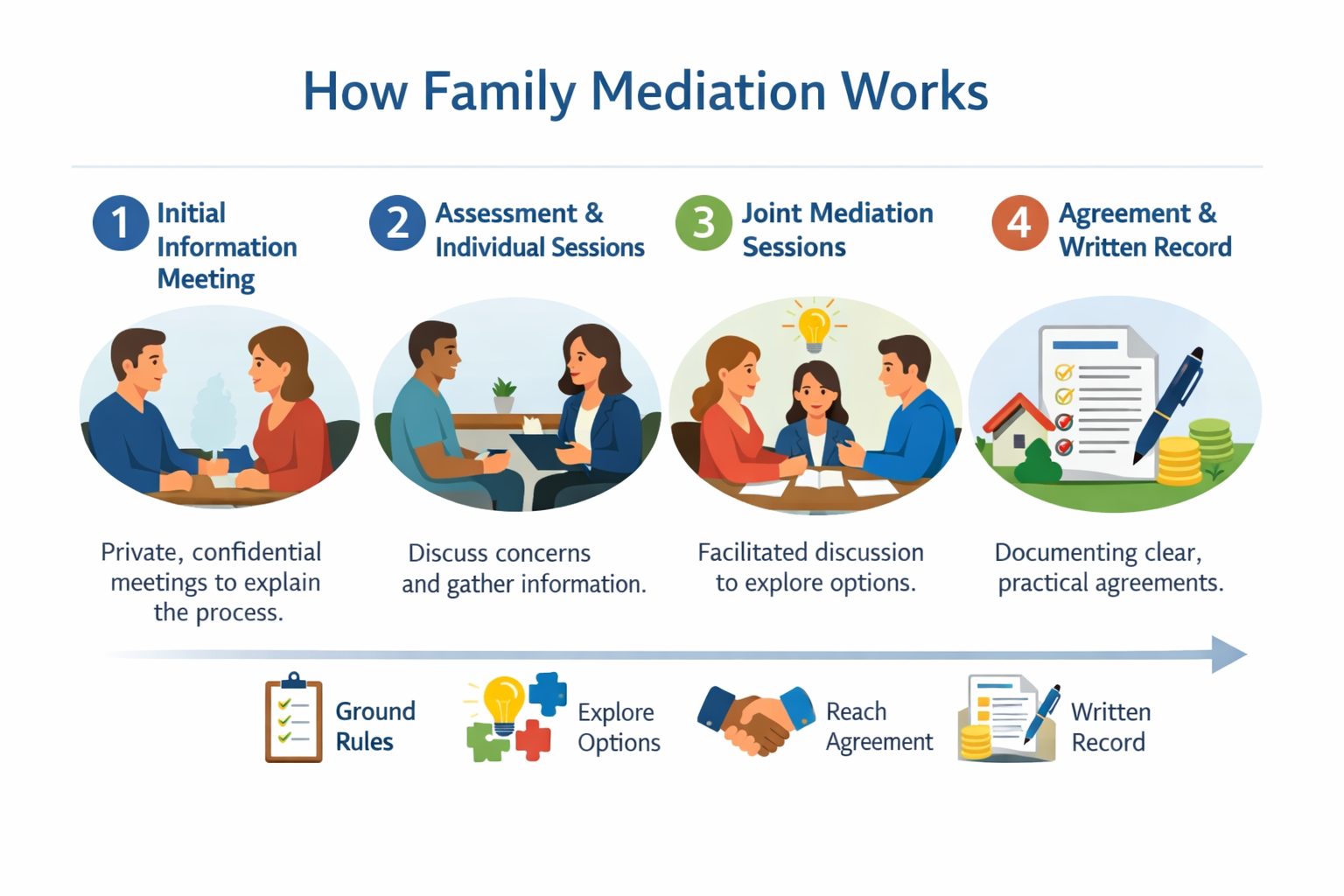
Each mediation follows a clear, professionally managed structure. This ensures every voice is heard, key information is shared, and any agreements reached are both practical and sustainable.
A private, short conversation explains the service, clarifies the voluntary and confidential nature of mediation, and identifies any safety concerns. Both parties are invited to separate initial meetings to set out their situation and priorities.
Where safety or power imbalance concerns exist, individual meetings allow each person to raise sensitive issues privately. The mediator gathers information and ensures everyone is ready to engage constructively in joint discussion.
Sessions follow a structured agenda: establishing ground rules, identifying each party's priorities, sharing relevant information, generating and evaluating options, and — where agreement is reached — recording clear, practical outcomes.
Agreements are recorded in plain English, designed to be easy to follow and easy to review. If legal formalisation is required — such as financial consent orders — the mediator explains the process for involving solicitors or the court.
Session length and timescales: Sessions typically run 60–90 minutes. The total number of sessions varies with the complexity of the matters. Some families reach agreement within a few sessions; others work through several meetings over a number of months, allowing time for information gathering or independent legal advice between stages. Timelines are discussed openly at the outset.
Mediation is appropriate for a wide range of family situations. It works best where both parties are willing to engage in structured conversation and consider practical options.
Families seeking a clearer, less adversarial path to settle child arrangements, division of household assets, and the practical steps that follow separation.
Parents who wish to focus on children's day-to-day needs and routines, building a co-parenting plan that is workable, consistent, and child-centred.
Separating couples who need structured support to clarify priorities, share financial information, and reach written agreements on assets and responsibilities.
Adult families managing decisions about care arrangements, legal powers of attorney, financial contributions, and long-term planning for elderly relatives.
Households navigating complex routines, shared responsibilities, and expectations across blended family structures — seeking sustainable, respectful arrangements.
Families and closely held enterprises where relationships matter, collaboration continues to be valued, and long-term working arrangements need to be preserved.
Mediation is not suitable where ongoing intimidation or coercive control is present, where a participant lacks capacity, or where unresolved criminal matters affect safety. In these circumstances, the mediator will explain alternative routes and signpost to appropriate specialist services.
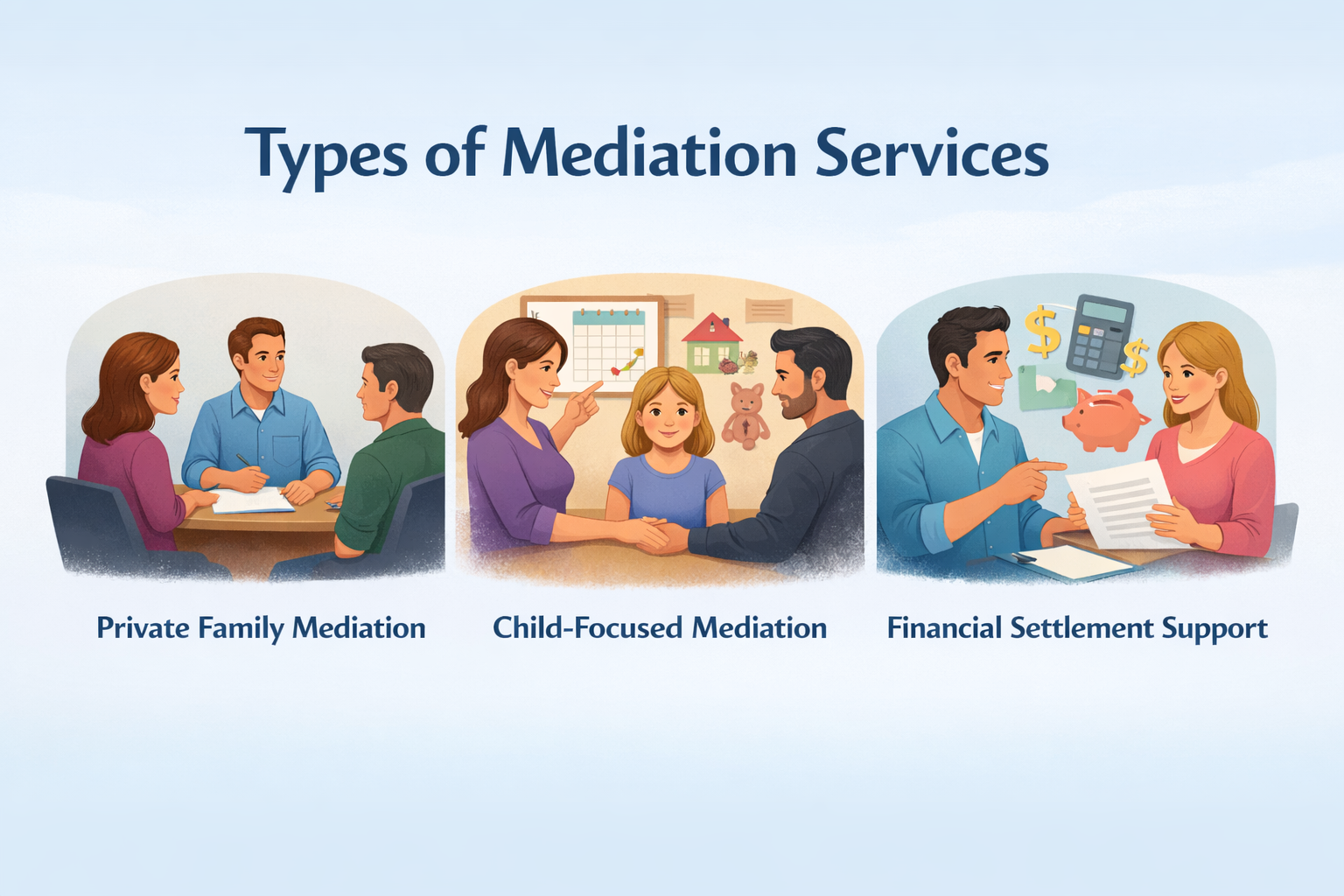
Each mediation service is structured around the specific needs of those involved. Below is an overview of the main service types and what they typically involve.
A confidential process where both parties meet — together or separately — with a neutral mediator to discuss family matters, identify priorities, exchange information, and negotiate agreements.
Co-parenting arrangements, contact and living schedules, written summaries for use with professional advisors.
Sessions that prioritise children's needs and routines. The mediator helps parents map out daily life, schooling, handover arrangements, and communication strategies that protect children from ongoing conflict.
Detailed parenting plans, communication protocols, and strategies for managing transitions including holidays and school changes.
Focused sessions to exchange basic financial information, identify each party's priorities, and test options for division of assets, liabilities, and ongoing financial responsibilities.
Agreement in principle on property, pension sharing, and a timetabled pathway for legal completion where required.
Facilitated conversations that explain options, manage expectations, and help couples prepare or review pre- and post-nuptial arrangements, ensuring any agreement is informed and mutually understood.
Clear statements of intent, asset declarations, and a structured process for obtaining independent legal advice.
Detailed planning sessions to help parents share responsibilities, manage education and healthcare decisions, and establish a clear, durable framework for resolving future disagreements.
Written co-parenting plans, communication guidelines, and structured review points as circumstances evolve.
Neutral facilitation for disputes affecting family businesses or closely held enterprises, focusing on preserving working relationships, clarifying governance, and reaching practical solutions.
Defined roles, agreed processes for managing future conflict, and a written memorandum of understanding.

Mediation is not a guaranteed quick fix, but it consistently delivers meaningful progress. Most families leave with greater clarity, better plans, and reduced ongoing conflict — even when not every issue is fully resolved.
Agreements are tailored to everyday realities — school timetables, work schedules, and children's routines — rather than a one-size-fits-all court order. You retain control over the outcome.
Structured mediation helps reduce stress, preserve dignity, and protect relationships that must continue — especially important co-parenting relationships. Conflict is channelled into productive problem-solving.
Agreements made through mediation are more durable because they reflect the people who must live with them. They can include review points that allow plans to adapt as circumstances change over time.
When agreement is not fully reached: Even where mediation does not resolve every issue, you will leave with a clearer understanding of where agreement exists and which matters remain in dispute. That clarity can reduce time and cost significantly if other resolution routes — such as solicitor negotiation or court proceedings — become necessary.
Our mediators hold accredited training and practical experience in family mediation. Credentials are described in plain terms so clients understand the mediator's training, experience, and professional responsibilities before the process begins.
We operate within a recognised professional framework, maintaining the ethical and practice standards expected of qualified family mediators across the United Kingdom.
Safety assessment is taken seriously throughout the mediation process. Where domestic abuse, coercive behaviour, or significant risk to a participant is identified, we will carefully assess the situation and recommend an approach that protects those who are vulnerable.
Mediation is not appropriate in all circumstances. Where it is not, the mediator will explain suitable alternatives and signpost to specialist organisations without delay. Adapted approaches — such as separate sessions or shuttle mediation — may reduce risk where direct contact is not safe.
Good mediation does not end when sessions conclude. The agreements reached, and the approach developed during mediation, are designed to support stability and cooperation long into the future.
After each stage, a concise written summary is provided so both parties are clear on what has been discussed and agreed. These records reduce the risk of future misunderstandings and provide a reliable reference point.
Where appropriate, agreements include planned review dates so that arrangements can be revisited as children grow, circumstances change, or new needs emerge. Plans are written to remain workable over time.
When independent legal advice would strengthen an agreement — for example, before signing a financial settlement — the mediator explains when and how to seek it, and what to expect from that process.
Where specialist support would benefit participants — such as financial advisers, pension specialists, or child welfare professionals — the mediator can signpost to appropriate services at any point in the process.
When legal formalisation of an agreement is required — such as a consent order or formal financial document — the mediator explains the steps involved and how solicitors or the court can be engaged to give the agreement legal standing.
Practical guidance is provided on maintaining consistent routines for children during and after the process — including consistent handover times, clear communication about holidays, and a shared approach to school arrangements.
No. You can attend mediation without a lawyer. Many people choose to seek independent legal advice at specific points — before signing a financial agreement, for example — and the mediator can explain when that would be beneficial and how to arrange it.
Mediation agreements are not automatically legally binding. You can choose to formalise an agreement through the courts or have it converted into a formal legal document with the help of solicitors. The mediator will explain the options for legal finalisation.
Usually yes, but not always. Where safety or power-imbalance concerns exist, sessions can be held separately — known as shuttle mediation — or online sessions can be structured so that both parties are not physically present together.
Mediation is voluntary and requires the participation of both parties. If the other person declines, you can still receive guidance from a mediator about the alternative steps available, including negotiation through solicitors or other dispute resolution options.
Yes, with specific legal exceptions such as safeguarding concerns or court orders. Confidentiality is fully explained at the first meeting. Mediators do not report the content of sessions to the court.
Yes. You may pause mediation at any point to obtain independent legal advice. Many people ask solicitors to review draft agreements before giving final approval. This can be arranged without disrupting the mediation process.
It depends on complexity. Straightforward matters can be resolved in two or three sessions; more complex financial or childcare arrangements may take several sessions over weeks or months. A realistic timeline estimate is provided early in the process.
Even if all matters are not resolved, mediation typically clarifies where agreement exists and which issues remain in dispute. That clarity can reduce the time and cost required if other resolution routes — such as solicitor negotiation or court proceedings — are subsequently needed.
Children are rarely present in mediation sessions. If children are to be consulted directly, this would only occur with careful agreement, appropriate professional oversight, and in a context specifically designed for that purpose.
Yes. Mediation can address pensions, property, and a wide range of financial matters. Complex financial issues may require specialist advice from financial advisers or pension specialists, and the mediator will explain when this is recommended.
Mediation can help parents discuss the practical implications of relocation and develop workable contact arrangements. For international moves, obtaining independent legal advice on the specific legal framework is strongly recommended as part of the process.
If you would like a friend, family member, or professional to accompany you to an initial meeting, this should be discussed with the mediator first. A support person can provide comfort, but they do not participate in mediation unless all parties agree.
Family meetings can be facilitated where appropriate. For sensitive business or inheritance disputes, targeted preparatory work to establish clear agendas is recommended. Neutral facilitation preserves the relationships and collaborative structures that matter to all involved.
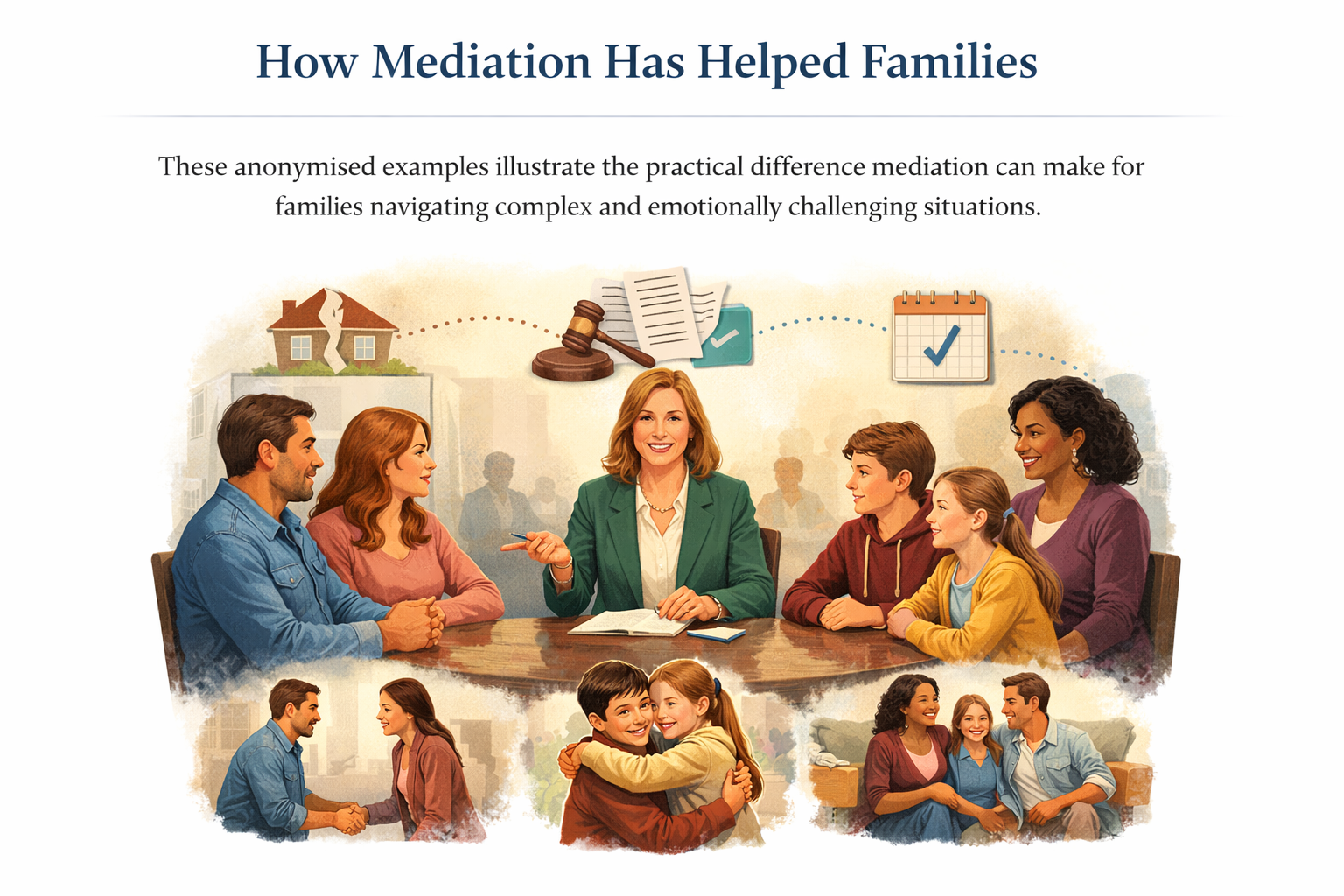
These anonymised examples illustrate the practical difference mediation can make for families navigating complex and emotionally challenging situations.
After separating, one couple found it was not the major decisions that caused tension — it was the everyday logistics. School drop-offs were repeatedly disputed, handovers became emotionally charged, and last-minute changes caused ongoing frustration. Communication had broken down to the point where even simple logistical messages felt confrontational.
In mediation, the focus shifted from past grievances to practical planning. Working hours, school commitments, extracurricular activities, and grandparent availability were mapped out together. A structured week-by-week parenting schedule emerged, including collection times, holiday arrangements, and contingency plans for illness or work changes — written in plain language with a built-in review date.
A separating couple faced deep uncertainty around their jointly owned property, with differing expectations about its sale and concerns over financial security on both sides. Mediation created a structured environment to examine the full financial picture together — assets, liabilities, ongoing expenses, and housing needs carefully listed and discussed.
Rather than debating fixed positions, the conversation centred on practical realities. A staged timetable for preparing and marketing the property was agreed, interim financial responsibilities were made transparent, and a clear process for obtaining a valuation and instructing solicitors was established. Prolonged litigation was avoided, saving both time and emotional strain.
Three adult siblings held differing views on how best to care for their elderly parent. Concerns about safety, independence, and financial contribution had created tension and stalled decision-making entirely. Mediation provided a neutral setting where each sibling could express concerns without interruption.
Options including in-home care, shared living, and residential support were explored alongside realistic costs. Through guided discussion, responsibilities were allocated according to availability and individual strengths. A visit rota, a transparent budget plan, and a clear process for day-to-day care decisions were agreed. The resulting plan restored communication and reduced stress for the whole family.

Each session is structured to ensure every voice is genuinely heard. Identifying priorities, exploring options, testing practicalities, and recording agreements in plain language — each step is designed to move from conflict toward clarity.
Fairness in mediation does not mean a precise legal ruling. It means agreements that balance the practical needs of everyone involved — arrangements that can actually be followed day to day. We encourage openness about priorities and realistic discussion about what can be achieved.
Our service is grounded in respect. We work with individuals and families from all backgrounds, cultures, and belief systems, recognising the diversity of modern family life. Every participant is treated with dignity and care throughout the process.
Confidentiality, safeguarding limits, the mediator's role, and the nature of any agreement are all explained clearly at the outset. There are no surprises. Participants make informed choices throughout the process.
We are committed to making mediation accessible for everyone. Reasonable adjustments can include:
If you require specific support, please mention it in your initial enquiry so arrangements can be made in advance.
Making decisions about separation, parenting arrangements, or family change can feel overwhelming, especially when emotions are still raw. Mediation offers a structured, neutral space to move through those decisions with clarity and care.
Our service offers steady, practical help when it is needed most — neutral guidance, child-centred planning, and flexible delivery to support realistic agreements that families can genuinely live with. Even when negotiations are difficult, mediation helps people leave with clearer plans, fewer misunderstandings, and a path to rebuilding a calmer everyday routine. A confidential initial discussion with one of our mediators is always the first step.